

ADINO – Adaptive Intelligence For State-aware Industrial Optimization
The project develops artifical intelligence (AI) based solutions into the processes of the manufacturing industry.
Duration: 1.1.2026 – 31.12.2028
Region: National
Financed by: Business Finland
Budget: 800 000 €
Project Manager: R&D Speacialist Saurav Khadka
ADINO – Adaptive Intelligence for State‑aware Industrial Optimization
The ADINO project develops human‑centric, state‑aware AI solutions that help industrial companies optimize production, resource flows, and decision‑making in real time. The project is jointly implemented by Centria University of Applied Sciences and Turku University of Applied Sciences, in close collaboration with industrial partners.
Modern factories generate vast amounts of data from machines, sensors, systems, and people, yet this data is often fragmented. ADINO addresses this challenge by integrating AI, IoT, digital twins, vision systems, and human input into a unified framework that improves efficiency, safety, sustainability, and competitiveness—while keeping humans in control.
At its core, ADINO focuses on augmenting workers, optimizing material and energy flows, and monitoring machines proactively. AI continuously analyzes the operational state, highlights risks and anomalies, and provides clear, explainable recommendations to support faster and better decisions on the shop floor.
Project Goals
- Optimize industrial resource flows involving workers, materials, machines, and energy
- Enable real‑time situational awareness through AI, IoT, and digital twins
- Improve energy efficiency, quality, and workplace safety
- Support human‑centric AI, where AI assists rather than replaces operators
- Strengthen collaboration between research institutions and industry and develop scalable AI business models
Example Pilots
ADINO pilots demonstrate practical impact in real industrial environments:
- AI‑assisted work reporting: capture spoken explanations and photos, auto‑generate ERP/MES reports
- Ergonomics and safety monitoring: detect physically risky movements using video‑based pose tracking
- Material flow tracking: combine logs and cameras to prevent picking errors and expose bottlenecks
- Predictive maintenance: detect early breakdown risks from sensor, log, and operator data
- AI‑based quality inspection: flag visual anomalies with scores and highlighted areas for fast human verification
Human‑Centric AI Vision

Centria University of Applied Sciences and Turku University of Applied Sciences are implementing the project in cooperation. The aim of the higher education institutions is to increase competence and share knowledge in close cooperation with companies with the aim of raising the level of competence in AI, Deep learning, Data Analytics techniques and advanced production technologies.

International Research Partners
1. University of Birmingham United Kingdom
Research partner contributing to advanced intelligence and industrial AI methods
2. Fraunhover Institute for Machine Tools and Forming Technology (Fraunhover IWU) Germany
Research partner specializing in smart manufacturing, digital production systems, and industrial optimization
3. Hamburg University of Applied Sciences (HAW Hamburg) Germany
Research partner supporting applied research in industrial automation and human-centric manufacturing systems
Saurav Khadka leads the ADINO-project
Saurav Khadka, Project Manager of the ADINO project, works in Centria Robotics and artificial intelligence top research group. He holds a master of science degree from Aalto University, specializing in robotics, control engineering, and autonomous systems.
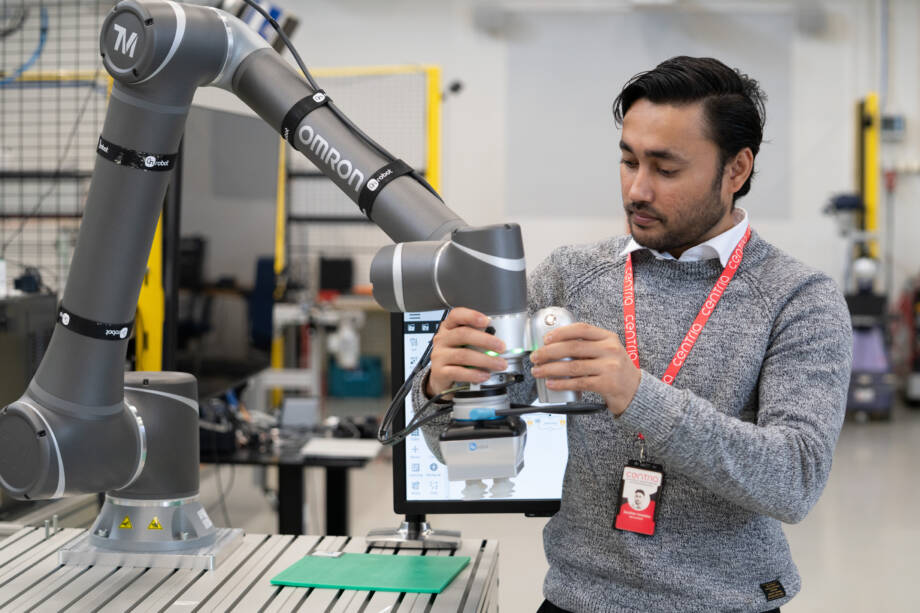
As a passionate follower of the latest robotics and AI advancements, Khadka regularly reads the latest research articles in the field and strives to apply their insights to his projects.
– I’m a robotics specialist, but I’m constantly studying artificial intelligence. My goal is to combine these two fields so we can benefit from both. At the same time, I conduct my own research and hope to contribute to the scientific community. I publish academic articles and share my expertise in robotics and AI with colleagues and local companies.