Advanced robotics development: from Finland to Italy
A solution developed at Centria was integrated into the research environment of the STIIMA Institute of the Italian National Research Council (CNR) during an expert exchange, where it was utilized in experimental research.
During the expert exchange, Centria’s research and development work in robotic arm teleoperation, robot data collection, and artificial intelligence was implemented at the STIIMA Institute of the Italian National Research Council (CNR). The teleoperation system enables the collection of synchronized camera images, robot states, and action data, which can be used to train AI models for robotic manipulation tasks. Robotics and AI Specialist Saurav Khadka brought the technology from Centria to Italy as part of the exchange.
The development work was based on research conducted within the CoRI5.0 – Cognitive Robotics Initiative for Industry 5.0 project. The project focuses on developing intuitive robot programming methods and enhancing human-robot collaboration. It also aims to advance cognitive robotics solutions to meet the needs of the manufacturing industry.
In the video, Khadka explains how the solution implemented in Italy works in practice: : https://www.youtube.com/watch?v=H60wjojz0rs
During the exchange, the solution developed in Finland was integrated into an Italian research environment, where it was used in experimental studies. The collaboration involved teleoperating industrial robots to collect demonstration data and using this data to train an AI model. At the same time, researchers investigated robot safety, controllability, and human-robot interaction.
The AI model represents one of the latest advancements in robotics and artificial intelligence, known as Vision-Language-Action (VLA) models. These models can interpret natural language instructions and generate robot actions to perform tasks autonomously. Once trained, the robot can execute learned tasks based on simple natural language instructions, without requiring users to write robot programming code.
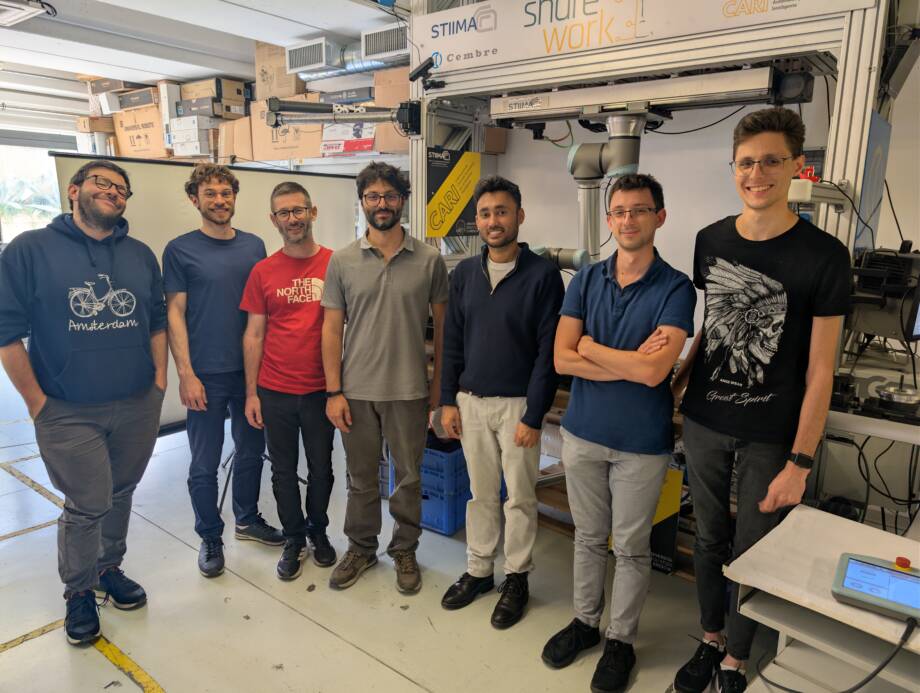
One of the key objectives was to establish a connection between teleoperation, AI-driven decision-making, and safe robotics. Experiments conducted in an international research environment provide valuable insights into how future industrial robots can operate more flexibly alongside humans. The expert exchange strengthened research collaboration aimed at developing safe, intelligent, and human-centered robotics solutions for the industry of the future.
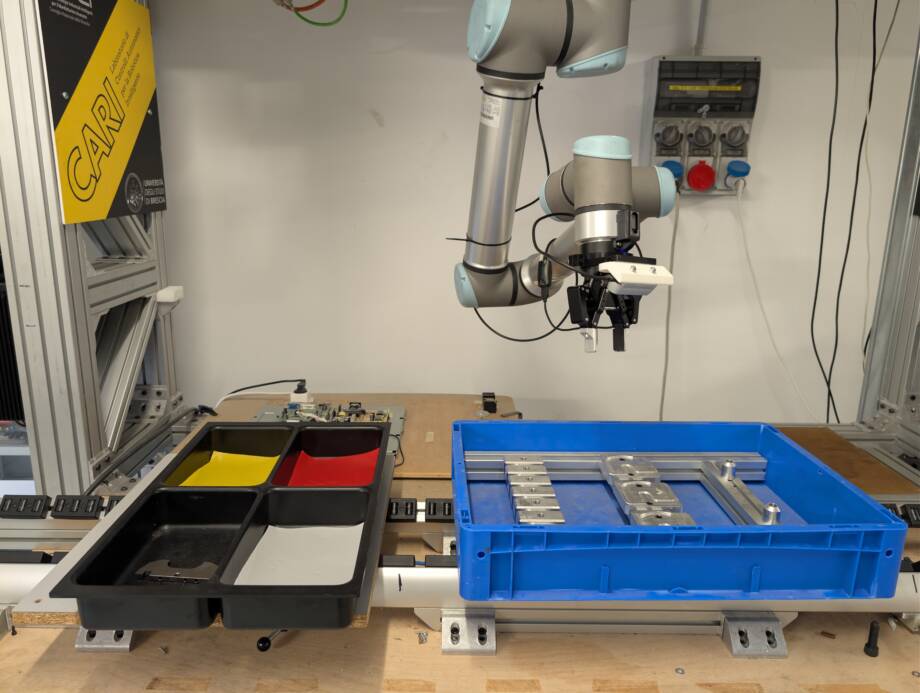
The collaboration will not end with the expert exchange. Joint research activities will continue through new experiments in the future. The international network is expected to expand further, as cooperation will continue both with Italian research partners and with a Nordic research organization. A new research exchange at UiT The Arctic University of Norway is planned for next year, and the partners also intend to prepare scientific publications based on the results.
Robotics and AI expert Saurav Khadka, who works in the Robotics and Artificial Intelligence research group at Centria, holds a Master of Science in Engineering degree from Aalto University and specializes in robotics, control engineering, and autonomous systems. He serves as Project Manager of the CoRI5.0 – Cognitive Robotics Initiative for Industry 5.0 project, funded by the European Regional Development Fund (ERDF) and the South Savo Centre for Economic Development, Transport and the Environment (ELY Centre). The project is implemented jointly by Centria University of Applied Sciences, Satakunta University of Applied Sciences, Turku University of Applied Sciences, and Vaasa University of Applied Sciences.