

Property Battery 2030
Branch: Chemistry and bioeconomy
Duration: 1.8.2025–31.7.2027
Region: National
Financed by: Pohjois-Suomen elinvoimakeskus
Budget: 101 762 €
https://net.centria.fi/hanke/kiinteistöakku2030
Project Manager: Anna Kwokori

Property Battery 2030 is a nationwide research and development project aimed at promoting the large-scale adoption of property batteries in Finland. The project supports household energy self-sufficiency, reduces energy costs, and increases the use of renewable energy. Its goal is to remove barriers to the deployment of property batteries—whether they are economic, technical, or informational—and to respond to changes and price fluctuations in the electricity market. Additionally, the project develops expertise, new business models, and services that support energy efficiency and sustainable development.
Property‑level batteries play a key role in increasing the flexibility of the energy system. They make it possible, for example, to store solar and wind power and use it when electricity demand is at its highest. The Property Battery 2030 project develops and pilots new technical solutions, compares international markets and legislation, and creates tools and business models for households and companies.
“Together with our project partners, we are organising a national Road Show tour that promotes the spread of best practices, strengthens cooperation, and supports the adoption of property‑level batteries across the country,”
says Centria’s Project Manager Anna Kwokori
Themes
- International comparative analysis
- Technical implementation and pilot projects
- Economic models and simulation platform
- Life cycle analysis and environmental impacts
- Tour, workshops, and networking
Results
- Open report on markets and legislation
- Technical comparison and installation guidelines
- Virtual simulation platform
- New business models
- Life cycle analysis and environmental report
Impact
- Sustainable energy system in Finland
- Increased prevalence of property batteries
- New innovations and jobs
- Growth in business competitiveness
11/2026 Kiinteistöakku2030 Roadshow: Kokkola Material Week Offered Valuable Encounters and New Perspectives on Energy Storage
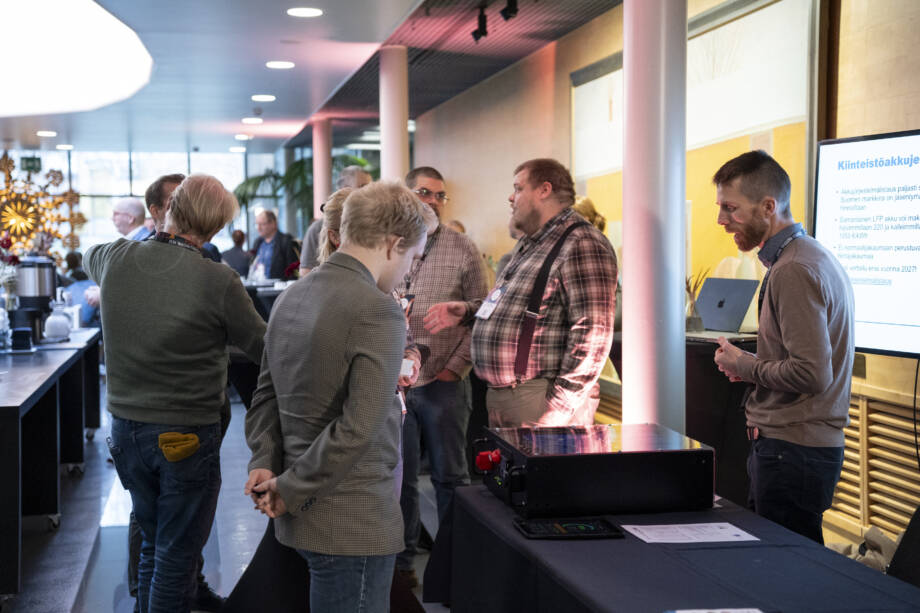
Kiinteistöakku2030 participated in the GeoKokkola Day of Kokkola Material Week with its own exhibition stand and also organized a dedicated seminar alongside the event, attracting a large audience interested in battery storage solutions. The seminar offered diverse perspectives on battery energy storage markets, technologies, profitability, and sustainable solutions.
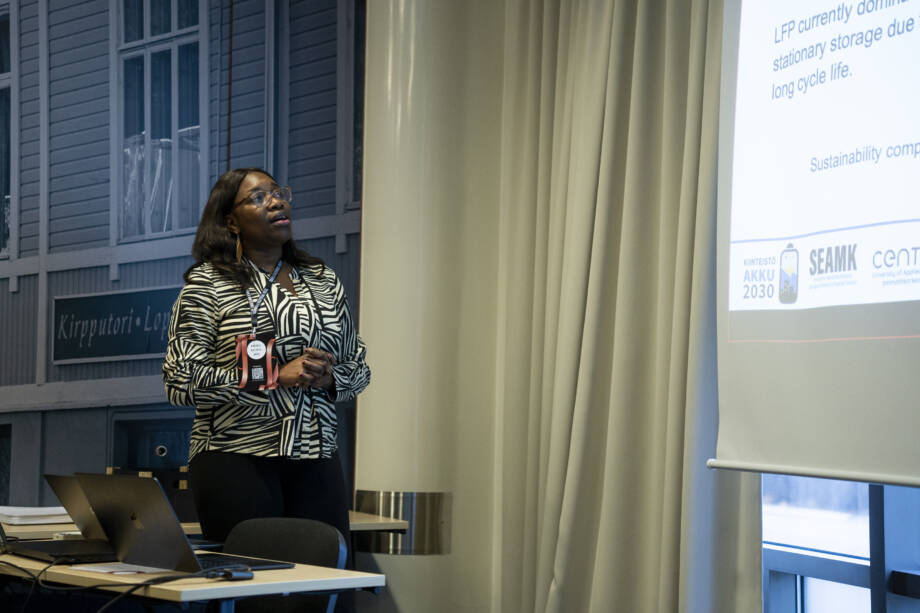
Project Manager Visa Siekkinen opened the seminar with an overview of the current battery market situation and price trends. Denise Conway presented the opportunities of Heliostorage’s large-scale battery systems for energy storage. Johan Dams gave an inspiring presentation on his personal project of building a completely off-grid detached house powered independently of the electricity grid. Anna Kwokori examined building-scale battery systems from a life cycle assessment perspective, while Perttu Palkia introduced the online calculator developed within the project, which can be used to evaluate the profitability of battery storage investments.
The Kiinteistöakku2030 Roadshow will continue at the Power Coast – Virtaa rannikolle 5 event on 26 November, where a dedicated seminar session on battery energy storage systems will also be held. Welcome to join us!
11/2026 Property Battery Seminar offers insights into energy storage opportunities
How do property battery systems affect energy costs, profitability, and energy self-sufficiency? The Property Battery Seminar brings together industry experts, companies, and property owners to discuss current energy storage solutions and practical experiences.
The event will feature presentations on the benefits of property battery systems, their economic viability, and their role in the future energy system. The seminar also provides an opportunity to network and exchange experiences with professionals active in the field.
Join us to learn how energy storage can create new opportunities for properties and businesses.
Read more and register: Property Battery Seminar
10/2026 Estate battery LCA calculations
Battery environmental impacts must be assessed from a full life-cycle perspective, as the majority of the climate impacts associated with residential battery energy storage systems occur during manufacturing and transportation. A recent assessment examined a 15 kWh battery system under Finnish operating conditions and compared sodium-ion and lithium iron phosphate (LFP) batteries. The results show that sodium-ion batteries offer several environmental advantages at the cell level, including lower material consumption and a smaller carbon footprint. However, the overall environmental performance of a battery system is also determined by end-of-life treatment and recycling processes.
“It is not yet possible to determine the most environmentally sustainable option based solely on a single material or battery technology. Only by considering the combined impacts of manufacturing, use, and recycling can we gain a reliable understanding of environmental performance,” says Anna Kwokori, RDI Specialist at Centria.

12/2025
Uusia ratkaisuja kestävään akkutuotantoon ja energian varastointiin – Centria
Seinäjoki University of Applied Sciences (SEAMK) – coordinator
Vaasa University of Applied Sciences (VAMK)
South-Eastern Finland University of Applied Sciences (XAMK)
Centria University of Applied Sciences
Turku University of Applied Sciences