Behind the lab door: Life as an RDI Expert
In my previous post From chemistry student to research and development specialist, I shared more about how I found my way into the field of chemistry and eventually to Centria. This time, I would like to give you a glimpse into what RDI work looks like in practice and what my days usually consist of.
Working in RDI is interesting because no two days are exactly alike. A typical workweek is often built around questions such as: What do we want to investigate or find out next? What kinds of tests will be required? What analyses are needed? Some people may imagine that chemists and researchers spend all their time in a fume hood mixing chemicals. In reality, the job includes much more than that, such as meetings, planning experiments, analyzing samples, reading scientific articles, and reporting results.
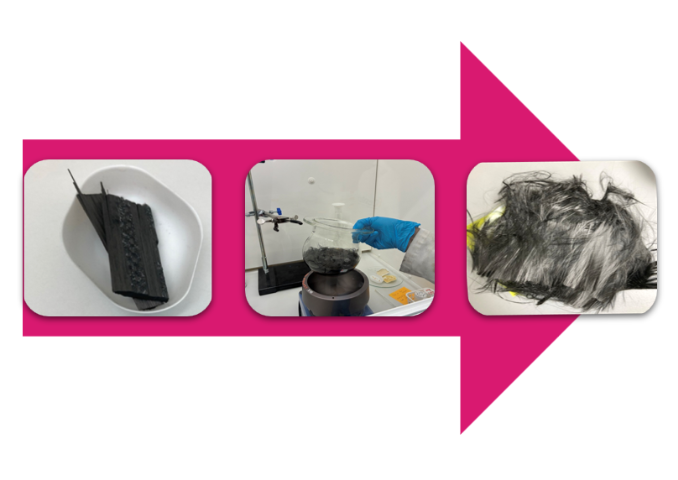
At Centria, composite-related projects focus on topics such as fiber and resin recovery. A typical experiment proceeds roughly as follows: first, a piece of composite material is allowed to react with a solvent at a specific temperature. After the reaction, the fibers are filtered and washed. This is the first stage of the process. In the second stage, the filtered solvent is further treated through steps such as neutralization and precipitation. During the process, solvents are removed by distillation, and eventually a small amount of brown, viscous material remains at the bottom of the flask: the recovered resin.
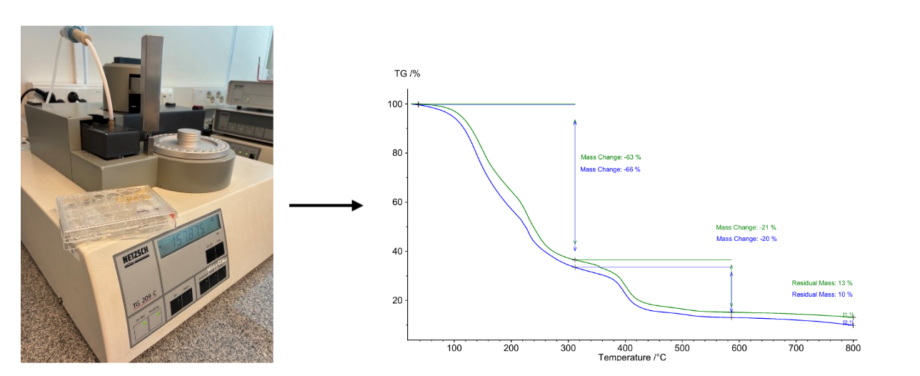
Experimental research relies heavily on analytical instruments to examine what happened during an experiment and what conclusions can be drawn from the results. The findings guide the next set of tests. Sometimes the conclusion is that a method simply did not work at all, while at other times the results are exactly what we hoped for.
In my work, I use thermogravimetric analysis (TGA) to study the purity of recovered fibers. TGA measures changes in a sample’s mass while it is heated. A significant mass loss indicates that impurities are still present in the fibers. If the mass change is negligible or non-existent, it suggests that the dissolution process was successful and that the fibers are very clean.
Another analytical method commonly used in research is Fourier Transform Infrared Spectroscopy, better known as FTIR. This technique provides information about the functional groups present in a compound. For example, it can be used to compare the original resin in a composite material with the recovered resin obtained at the end of the process, or to compare distillation fractions with a pure solvent.
What I enjoy most about my work is the opportunity to apply what I have learned and to experience those rewarding “aha” moments when something finally makes sense. I also appreciate the variety of the work, as it constantly offers opportunities to try new things and further develop my expertise.
In research, even a result that initially appears disappointing can be valuable. Sometimes the most important finding is discovering that a particular method does not work as expected. In some cases, the method can be further developed and improved, while in others it becomes clear that continuing the investigation is not worthwhile. In both situations, however, something new has been learned. This is at the heart of RDI work: every result increases our understanding a little further and helps guide us toward better solutions.
Reetta Mattila
TKI-asiantuntija
Kokkola