From Industry to Research – Connecting the Dots Through Sustainable Materials
Some career paths are planned from the beginning. Mine was printed layer by layer.
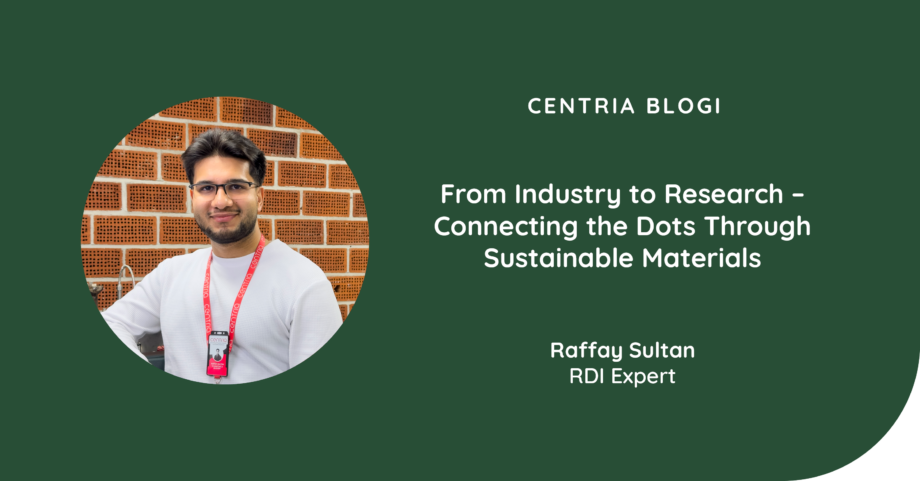
Just before graduating, I received an opportunity that would shape the direction of my career: an Erasmus+ exchange internship in the Department of Resource Recovery at a university in Sweden. As a Research Assistant, I worked on the 3D printing of polypropylene reinforced with hemp fibres, studying the material’s mechanical, water-absorption, morphological properties and printability.
During two intensive months in the laboratory, I successfully developed composite materials and turned them into 3D-printed samples. Seeing those first samples emerging from the printer was deeply rewarding. Something that had previously existed only as an idea or topic to attempt from my supervisor turned into pellets of composite formulations, and a series of experimental 3D printing trials turned it into a real object that I could hold in my hands.
The work later resulted in the successful publication of a research article (Sultan, Skrifvars & Khalili 2024). More importantly, it introduced me to the possibilities of combining polymers, natural fibres, and additive manufacturing. I began to understand how materials that are overlooked or treated as waste can become valuable resources for new and sustainable products.
My thesis strengthened that interest further. I investigated the 3D printing of carbon-fibre-reinforced PET (Sultan 2023). The thesis received the highest grade, 5/5. The grade was encouraging, but the experience meant much more than academic recognition. It helped me realize that polymers, composites, and 3D printing were not simply subjects I enjoyed studying. They represented the field in which I wanted to specialize and build my career.
I began to see that industry and research are not separate worlds; they are different stages of the same journey from an idea to a meaningful product.
After graduation, I focused on learning Finnish language and reached an intermediate level. For me, it was also a way to understand Finnish society, communicate with people, and become more connected to the country in which I was building my future.
My next opportunity took me into the Finnish composite industry. I joined a composite company in Finland as a Research and Design Engineer at an exciting stage in the company’s development. The pilot factory was scaling towards larger production, while the material, products, and manufacturing processes were still being continuously improved.
In under ten months, I contributed to multiple projects involving sustainable wood-based composite materials for interior products. Together with colleagues from research and development, design, and production, I worked to increase the bio-based content of material formulations while maintaining their performance and manufacturability. I also helped to improve scratch resistance, durability, and mechanical properties, developed coating systems, tested customized colours, and prepared technical drawings and documentation.
It was meaningful to see our joint work support the production at the new factory with better products. Every improvement, whether in surface quality, material performance or processing, brought the product closer to meeting customer expectations.
At the same time, working in industry taught me an important lesson about the relationship between research and production. Industrial development must respond to production schedules, customer requirements, and commercial targets. Solutions are often needed quickly. Research, however, moves differently. Materials require repeated trials, careful testing, and sometimes many failures before the desired result are achieved.
I began to see that industry and research are not separate worlds; they are different stages of the same journey from an idea to a meaningful product.
In an industrial environment, development naturally focuses on the issues that most directly affect production and customers. However, some challenges begin at the microscopic level, deep within the structure and behavior of the material. These questions require time and focused research and development before a material reaches the piloting and production stages.
This understanding led me to my next chapter: returning from industry to research as an RDI Expert at Centria University of Applied Sciences in Chemistry and Bioeconomy team. I now work in the plastics, composites, and 3D-printing research group, contributing to projects focused on sustainable materials and innovation.
My work includes developing and testing composites, analyzing their mechanical performance, optimizing material-processing methods, and preparing feedstock for 3D printing. I also participate in data interpretation, project planning, and coordination. Here, I have the opportunity to investigate material challenges more deeply and help to address fundamental issues before technologies move towards industrial piloting.
Like 3D printing itself, progress happens layer by layer.
Looking back, the different stages of my journey now seem connected: my Erasmus+ internship in Sweden, my thesis, learning Finnish, working in the composite industry, and finally joining Centria. Each experience has added another layer to my expertise and helped me understand the complete path of material development from a laboratory idea to an industrial product.
Every day offers a new opportunity to explore the world of sustainable materials. By reusing fibres, developing recyclable composites, and creating materials for future manufacturing technologies, I feel that my work contributes to something larger than an individual project.
My transition from industry to research was not a step away from industry. It was a step towards understanding its challenges more deeply and helping to create sustainable solutions before they reach the factory floor. Like 3D printing itself, progress happens layer by layer. Each experiment adds knowledge, each challenge creates a new question, and each successful material brings us a little closer to a more circular and sustainable future.
References
Sultan, R., Skrifvars, M. & Khalili, P. 2024. 3D printing of polypropylene reinforced with hemp fibers: Mechanical, water absorption and morphological properties. Heliyon, 10(4), e26617. Available at: https://doi.org/10.1016/j.heliyon.2024.e26617. Accessed 2 September 2026.
Sultan, R. 2023. The influence of infill orientation and surface machining on the fatigue performance of additively manufactured carbon fibre reinforced polymer. Arcada University of Applied Sciences. Available at: https://urn.fi/URN:NBN:fi:amk-2023101727677. Accessed 2 September 2026.
Raffay Sultan
RDI Expert
Kokkola